

Introduction
For battery manufacturers, electric vehicle (EV) brands, and OEMs exporting to the European market, supply chain traceability is no longer just a matter of prestige or sustainability reporting. As the strict legal timeline set by the European Commission rapidly tightens, companies attempting to track complex data across vast supply networks using manual systems or isolated databases are taking a massive commercial risk. The penalty for non-compliance is not merely a fine; it is the direct loss of access to the European market.
In this landscape, sustainable economy goals have become a prerequisite for existence in global trade and for maintaining a competitive advantage. At the center of this unprecedented data transformation lies blockchain technology, which secures complex supply chain data involving multiple stakeholders with 100% certainty. In this article, we take a deep dive into why verifying the origin of data is vital in the battery industry and how companies can protect their operational integrity using technology in this new regulatory era.
Sustainable Economy and the Need for Transparency in the Supply Chain
Traditional linear production and consumption models (take-make-dispose) are rapidly giving way to circular and sustainable economy approaches. It is now mandatory to prove every step of the process—from the extraction of critical raw materials like lithium, cobalt, and nickel to final cell assembly—including carbon emissions. For industry leaders, achieving ESG (Environmental, Social, and Governance) goals is no longer possible through abstract promises, but only through verified data.
The EU Battery Regulation demands unprecedented transparency from manufacturers at every layer of the supply chain. A battery’s carbon footprint, proof that materials were ethically sourced without child labor, and the environmental impact of production processes must be verifiable by independent auditors. In traditional centralized systems (ERPs or local databases), the risk of data manipulation is extremely high. In contrast, blockchain-based infrastructures provide an unshakable and definitive proof to regulators by cryptographically guaranteeing the immutability of data.
Battery Recycling and Circular Ecosystem Integration
One of the most critical and operationally challenging pillars of the new European legislation is the management of batteries that have reached their “End-of-Life.” The EU Battery Regulation does not just aim to prevent lithium-ion batteries from ending up in landfills; it legally mandates the use of specific minimum levels of recycled content in new batteries produced in the future.
To establish an effective and auditable recycling ecosystem, the following strategic steps must be technologically secured:
- Definitive Proof of Material Origin: Mathematically documenting exactly how much of the cobalt or lithium used in a new EV battery cell originated from a “black mass” processing recycling facility.
- Life Cycle and State of Health (SoH) Tracking: Reliably sharing a battery’s current capacity, cycle count, and repair history to facilitate second-life applications, such as stationary energy storage.
- Automated Reporting: Converting all these processes into a digital smart contract format that is instantly accessible to customs authorities and international auditors.
The Critical Balance in Data Management: Transparency vs. Commercial Privacy
A primary concern for C-Level executives and compliance departments is how to protect a company’s trade secrets while complying with strict regulatory rules. Openly sharing the entire sub-tier supplier network, cost structures, and supplier identities could severely damage a company’s competitive edge in the market.
This is exactly where the advanced cryptographic architecture of blockchain technology comes into play. Advanced methods such as Zero-Knowledge Proofs (ZKP) allow companies to prove that their data complies with legal limits without fully revealing the specific content of that data. For example, a manufacturer can prove a material is “ethically sourced and EU compliant” without disclosing the specific mine to their competitors. In this way, the transparency requested by regulators is fully provided while the manufacturers’ rights to competitive privacy are maintained at the highest level.
Centralized Solutions with Digital Product Passports (DPP)
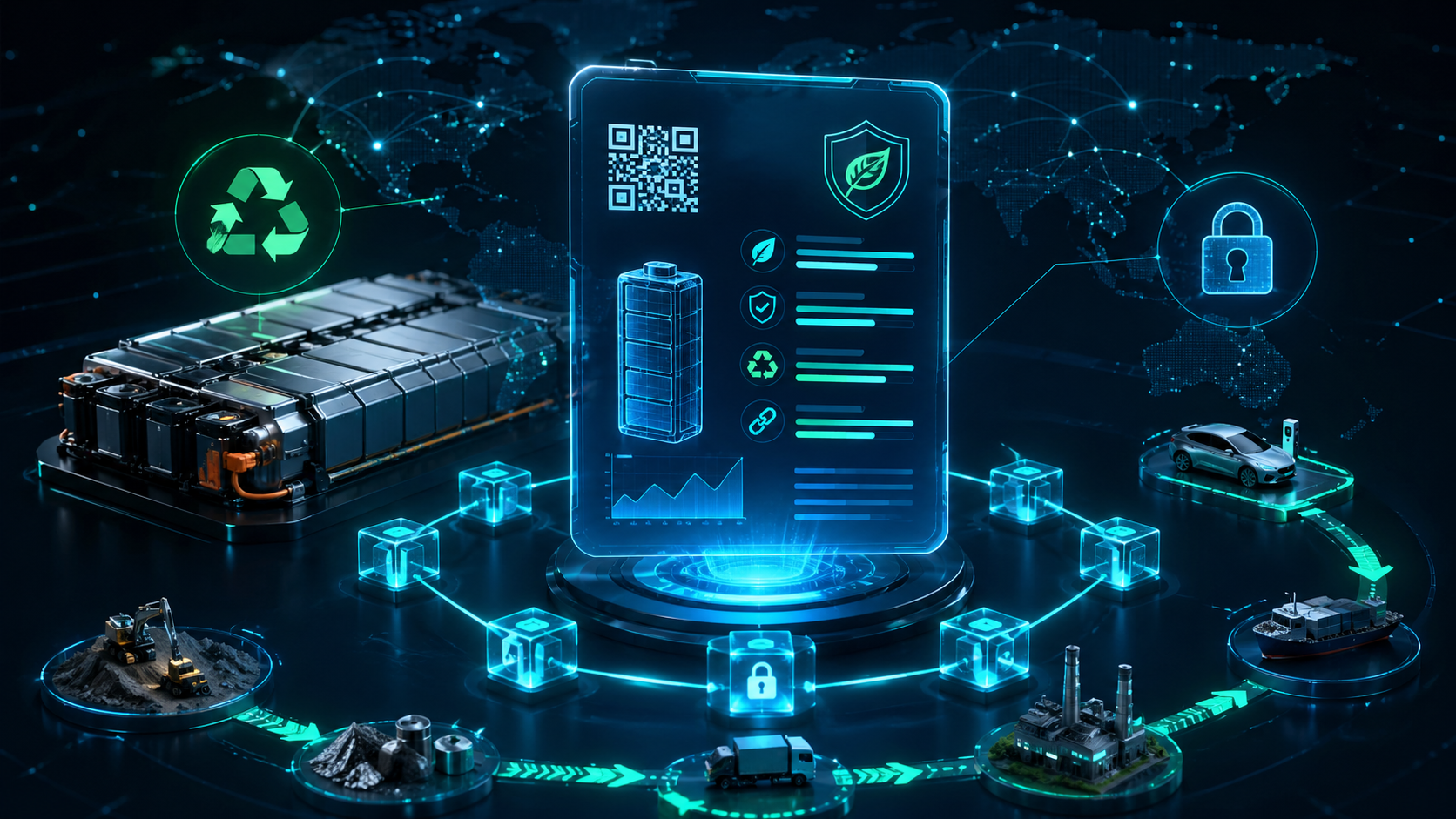
The only way to consolidate all these complex requirements under the EU Battery Regulation—carbon footprint targets, mandatory recycling quotas, regulatory transparency, and commercial privacy—is through Digital Product Passports (DPP). A DPP, acting as a digital twin of the physical battery in the cloud, ensures that data is transmitted instantly and securely to authorities, supply chain stakeholders, and end-users.
However, it must be remembered that the legal and commercial validity of a DPP depends entirely on the architectural reliability of the infrastructure on which it is built. A blockchain-based BATRIX Digital Product Passport eliminates all potential compliance and audit risks by making it impossible to delete or alter data entered into the system retroactively.
Expert Insight: The Future of the Industry
“Today, many OEMs and battery manufacturers fall into the trap of viewing Digital Product Passport requirements merely as an ‘IT integration’ or ‘creating a QR code.’ However, the real regulatory challenge is not just aggregating data, but proving to European authorities that the source of that data has not been manipulated. In the future sustainable economy model, companies that invest in decentralized technology infrastructures—offering both privacy and end-to-end traceability—will be the new market leaders. Those who delay this transformation risk being slowly phased out of global supply chains.”
Conclusion
The EU Battery Regulation marks the beginning of a new, irreversible era for the global battery and automotive industry. In this challenging process, ranging from carbon footprint declarations to strict recycling quotas and ethical supply chain audits, manual data management or traditional software are no longer viable options. To establish trust, guarantee data integrity, and protect your competitive advantage in the European market, you must transform your technological infrastructure today.
Meet BATRIX to ensure end-to-end compliance with EU Battery Regulations backed by blockchain and create your company’s Digital Product Passport (DPP) today. Discover our platform that ensures full transparency for regulators while protecting your trade secrets. Contact our expert team to digitalize your supply processes and request a demo now.